
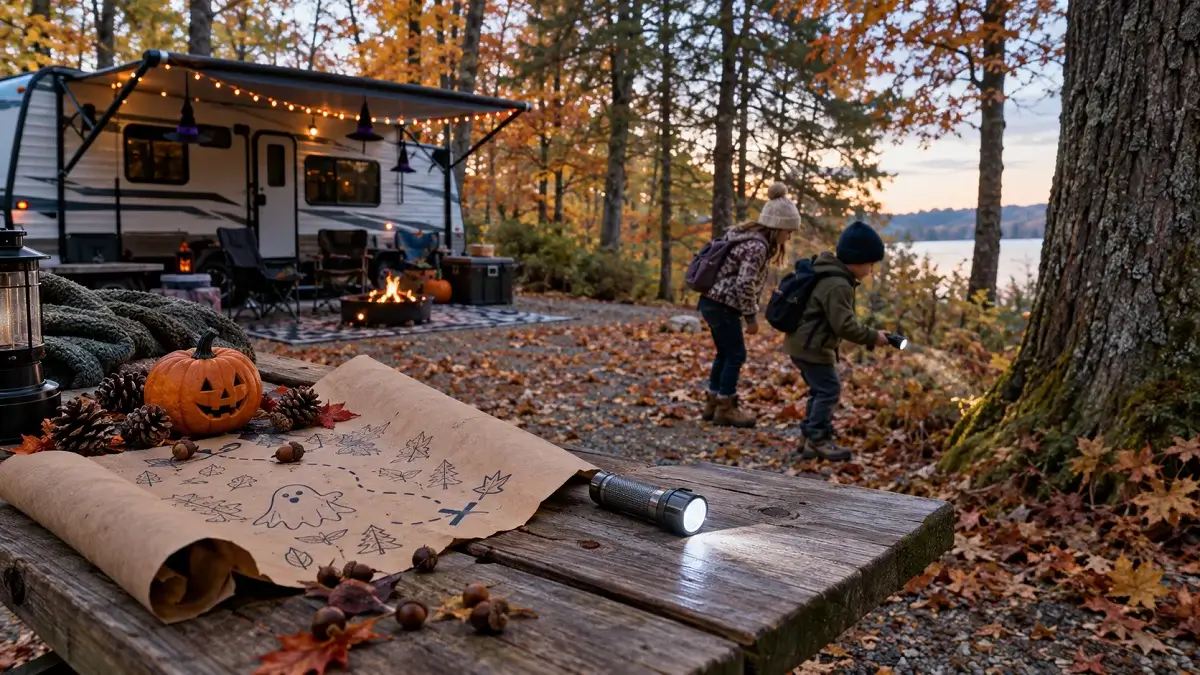
October campground weekends have a special kind of energy that indoor parties cannot duplicate. The crisp evening air smells like woodsmoke, leaves crunch under hiking boots, and RV rigs across every loop go all out with spooky holiday displays. Keeping children engaged between dinner and campfire marshmallow roasting, however, often turns into a battle against chilly fingers, roaming boredom, and phone screens.
Setting up a full outdoor game usually feels exhausting after a long drive and campsite setup. Long rule sheets get lost in the grass, intricate clues tear in the wind, and kids quickly lose interest if an activity requires sitting at a picnic table. The secret to a memorable evening is turning the campground into an active, self-guided adventure that taps into the strange shadows and creative RV decorations already around you.
A well-crafted halloween camping scavenger hunt lets kids explore the campsite loops safely while burning off pre-bedtime sugar. The list below blends natural woodland finds, easy RV decor spotting, and sensory challenges that fit any campground loop. Grab a couple of flashlights, pull on warm hoodies, and let the kids hunt for these spooky discoveries before the fire dies down.
1. Spot Three Glowing Jack o Lanterns Carved with Camp Themes
Campground pumpkin carving takes on its own distinct personality compared to neighborhood front porches. You will rarely find plain triangle faces when RVers break out their carving kits at the picnic table. Campers love etching classic outdoor themes right into the rind, turning ordinary gourds into miniature beacons along the site driveways.
Challenge the kids to look beyond typical toothy grins and search specifically for adventure motifs. These carved scenes usually stand out best right at dusk as owners light up their tea lights and glow sticks.
- Watch for miniature retro campers with tiny carved windows.
- Look for jagged pine tree silhouettes cut into the pumpkin face.
- Find a scene showing a ghost or skeleton toasting a marshmallow over carved flames.
Give younger hunters an edge by reminding them to scan picnic table benches and tailgate covers. Campers often place real carved pumpkins higher up on cooler tops to protect them from curious park raccoons.
2. Collect Five Odd Shaped Acorns Before Twilight Sets In
Oak groves scatter thousands of rough caps across campsite pads every autumn afternoon. To an imaginative child, these knobby nuts easily resemble petrified monster eggs or miniature witch hats hiding under leaf litter. The goal here is finding specimens with unusual quirks rather than standard garden variety nuts.
Give each child a small brown paper sack so their hands stay free while climbing gravel banks. Set a boundary line so nobody wanders past the gravel perimeter into thick brush.
- Pick up acorns with double caps joined together like twins.
- Find one with a long stem bent like a tiny hook.
- Search for smooth green caps that never turned autumn brown.
- Spot an acorn cap with a rough, shaggy fringe around the lip.
💡 Wildlife Etiquette Rule
Avoid taking nuts from big neat piles tucked inside hollow logs. Those are active winter caches gathered by chipmunks. Stick strictly to loose nuts scattered in open grass.
Have the kids dump their bags onto the camp table once gathered. Comparing the lumpy caps under a lantern makes for a fun break before heading into the next loop.
3. Track Down a Rig with Purple Awning Rope Lights
Orange string lights are standard camping fare in October, but deep purple awning illumination transforms an ordinary fifth wheel into an eerie haunted ship. The deep violet glow casts long, moody shadows across gravel pads without disturbing the dark campground sky.
Kids can spot this hue from multiple loops away as soon as dusk settles into full darkness. Walking toward the purple glow feels like navigating by a secret beacon through the trees.
Black cords hang limp along metal awning tracks, blending into the camper trim and looking completely ordinary.
A wash of violet light blankets the campsite gravel, highlighting cobwebs and hanging ghosts with high contrast.
- Stand on the campground road and look down every loop corridor.
- Check under motorized awning arms where LED tracks are permanently mounted.
- Watch for ground level stakes wrapped in violet rope light to mark outdoor rug borders.
Remind the group to keep voices hushed when approaching well lit sites. Other families often sit quietly right behind the awning screens enjoying their evening cocoa.
4. Feel for Tree Bark as Rough as Monster Scales
Halloween games get much more exciting when you bring the sense of touch into play. Woodland trails are packed with distinct bark patterns, from paper thin birch skins to deep, furrowed oak bark that feels like reptile armor.
Have kids keep their flashlights clicked off for ten seconds while resting their palms against a sturdy trunk. Feeling the texture in the dark heightens their senses and gets them paying attention to natural details they normally walk past.
Monster Texture Field Checklist
- Test three different tree varieties along your designated walking path.
- Run fingers down the north side of the trunk where soft moss creates a hairy texture.
- Check that nobody touches poison ivy vines clinging to the bark grooves.
Once everyone agrees a trunk qualifies as true monster hide, write the tree type down on the hunt card before moving on.
5. Find a Campsite Flying a Pirate or Witch Flag
RVers love expressing campsite personality through lightweight garden flags clipped to metal shepherd hooks. During late October, standard welcome emblems get replaced by fluttering skull graphics, witch boots, and glowing ghost banners.
These fabric signs flutter with the slightest mountain breeze, making them easy to catch out of the corner of your eye. They provide a reliable visual milestone for kids who need quick success early in the game.
- Scan the grassy strips directly beside RV electrical pedestals.
- Look for small solar ground spotlights pointed up at the flag fabric.
- Keep an eye out for tall telescoping poles mounted to rear camper bumpers.
Finding two different flags in one loop earns bonus points. It also teaches children to respect campsite borders while reading the graphics from the asphalt edge.
6. Listen for an Owl Call from the Tree Line
Camping in late autumn means earlier sunsets and long stretches of quiet woodland dusk. When the generator shutoff hour approaches, forest sounds carry clearly across the loops. Great horned owls and barred owls grow vocal right as temperatures plunge, making their low, echoing calls feel like a spooky soundtrack.
This clue requires kids to transition from fast walking to complete stillness. It acts as an intentional pause that calms exciting energy before things get out of hand.
Halt and Dim: Click flashlights to red mode or point them directly down at your boots.
Cup Both Ears: Curve your palms behind your earlobes to catch faint sounds drifting above the camper roofs.
Count the Beats: Listen for the classic four part rhythm that sounds like “Who cooks for you?”
- Move at least fifty feet away from rumbling heaters or furnace exhaust vents.
- Have everyone stay silent for a full thirty seconds by the camp watch.
- Note the general direction of the call without entering unlit woods.
If the owls stay quiet, substitute the crackle of dry pine branches overhead or the rustle of a scurrying raccoon. The real win is getting kids to tune into the night forest.
7. Locate a Fake Skeleton Relaxing in a Camp Chair
One of the most common Halloween campsite setups features plastic anatomical figures posed as casual campers. Seasoned RVers pose life-sized skeletons holding roasting sticks, wearing knit beanies, or lounging casually inside folding camp chairs under the awning.
Spotting these humorous tableaus turns a spooky walk into a lighthearted neighborhood stroll. Kids will love cataloging what the skeleton is supposed to be doing at camp.
Stay on the paved or gravel loop road while inspecting the scene.
Point low beam flashlights at the skeleton legs rather than RV bedroom windows.
Walking across the neighbor patio mat to touch plastic props.
Shining bright high powered beams into dark tow vehicle windows.
- Look for skeletons propped near unlit fire rings holding empty coffee mugs.
- Check passenger seats of pickup trucks where owners pose bony co-pilots.
- Note down any funny camping accessories the skeleton is wearing, like sunglasses or hiking shoes.
Kids can mark this item off their cards as soon as they identify the skeleton pose from the safe boundary of the camp road.
8. Bag a Fallen Leaf in Deep Pumpkin Orange
Fall foliage blankets state park campgrounds with an incredible spectrum of red, gold, and brown. Finding a leaf that matches the exact vibrant shade of a ripe carving pumpkin takes real scrutiny. Most leaves dull quickly once they hit the damp dirt floor, turning brittle and dark brown.
This clue turns every leaf drift into a vibrant sorting station. Kids will quickly learn that not every orange leaf meets the pumpkin standard.
| Target Pumpkin Quality | Common Scrap Quality |
|---|---|
| Firm, leathery sugar maple leaf picked from dry grass. | Soggy brown oak leaf collected from a drainage ditch. |
| Uniform fiery orange without black decay spots. | Dull mottled yellow leaf dried into brittle crumbles. |
| Clean stem intact for easy pressing in a camp journal. | Torn leaf fragments missing their tips or edges. |
- Direct the kids toward dry grassy clearings near campground water pumps.
- Compare candidate leaves side by side against a real pumpkin back at camp.
- Slip the winning leaf between the pages of a notebook so it survives the walk.
Taking time to evaluate the color spectrum keeps the hunt thoughtful rather than a frantic race around the asphalt.
9. Follow Reflective Trail Markers with a Low Beam Flashlight
Night navigation becomes an instant mystery when you introduce retroreflective trail blazes. Many state parks install small plastic diamonds or aluminum tacks on trees bordering campground loops to guide evening hikers back from the bathhouses.
When hit by direct flashlight beams, these tiny tags blaze through the trees like glowing monster eyes. Kids can practice sweeping their light beams low and steady to pick up the trail sequence.
Keep flashlights held at belt buckle height. Lifting lights to eye level blinds walking partners and washes out faint reflective markers hidden in the tree bark.
- Sweep light beams back and forth along trail edge trees roughly four feet up.
- Watch for twin reflectors set close together indicating a trail bend.
- Count three markers in a row before declaring the trail located.
This exercise sharpens focus while teaching children how reflective materials keep outdoor travelers safe after dusk.
10. Discover a Campsite Displaying Floating Witch Hats in the Trees
Suspending pointed black hats from campsite tree boughs using clear fishing line is a popular RV decorating trick. During the day, the line remains nearly invisible, making the hats look like they are hovering through sheer witchcraft.
At night, battery operated tea lights tucked inside the pointed cones make them glow softly among the autumn branches. Kids love peering upward into the canopy to find these airborne shapes.
⚠️ Headlamp Beam Etiquette
When looking up into campsite trees, remind kids never to turn their heads toward camper windows or seated campfires. A stray headlamp beam can easily blind someone relaxing in their camp chair.
- Look near outdoor dining canopies where strong low branches cross over.
- Check for soft amber glow points suspended five to eight feet in the air.
- Count how many individual hats form the floating coven above the site.
Marking this clue off the list gives kids a great reason to look up into the woodland ceiling instead of keeping their eyes glued to the pavement.
11. Identify Two Different Animal Tracks Pressed in Mud or Sand
Campgrounds turn into wildlife thoroughfares the moment daytime campers head inside their rigs. Soil near communal water faucets, muddy trailheads, and sandy wash out zones captures clean impressions left by wandering nocturnal critters.
Show kids how to look for clear toe pads, claw marks, and tail drag lines in soft dirt. It feels like tracking creatures through an uncharted wilderness right behind the campground bathhouse.
- Inspect soft soil around campground spigot drainage boxes.
- Check damp sandy edges where rain runoff collects along the road shoulders.
- Place a coin or acorn next to the track to scale its size before taking a photo.
Finding two distinct species confirms the campground is shared with real woodland creatures, adding an authentic thrill to the evening hunt.
12. Hunt for a Camper Door Hanging a Burlap Spiderweb
RV doors are narrow and exposed to driving rain, which means seasoned campers skip delicate paper decorations in favor of durable outdoor materials. Burlap, thick jute twine, and stretch cord make fantastic rustic spiderwebs that handle blustery campsite weather with ease.
Kids should scan camper screen doors, grab handles, and fold down aluminum entry steps for these textured webbing designs. They look far more authentic than synthetic white cotton batting.
- ▸Screen Door Weaves: Heavy cord tied into geometric web patterns over the aluminum mesh.
- ▸Grab Handle Cocoons: Burlap ribbon wrapped securely around entry handrails.
- ▸Tire Cover Traps: Thick rope webs stretched across spare camper tire mounts.
- Look for giant plastic arachnids pinned right in the center of the rope webbing.
- Check whether the web uses natural tan jute or dyed black outdoor cord.
- Record the site number on the scorecard so everyone remembers the best decorated camper door.
This search encourages kids to look closely at camper architecture and how creative outdoor families adapt decorations for travel trailers.
13. Gather Four Pinecones to Build a Miniature Camp Monster
Woodland ground floors under tall evergreens offer an endless supply of craft materials. Searching out pinecones with distinct shapes gives kids the parts they need to build their own campfire creature once they return to home base.
Rather than grabbing the first four pinecones they step on, encourage the team to look for different sizes and structures that can serve as heads, torsos, and clawed feet.
- Pick one long white pine cone to serve as the monster body.
- Select two short, rounded pitch pine cones for clawed feet.
- Find an open, flared cone whose top scales look like wild monster hair.
- Collect small dry twigs to join the segments together back at the table.
Packing these natural craft supplies back to camp ensures the entertainment keeps rolling even after the formal scavenger hunt walk wraps up.
14. Find a Campsite Outdoor Rug with Ghost or Bat Patterns
Patio mats are an essential part of RV living, keeping gravel, pine needles, and trail dirt outside the camper door. During autumn, many full-time travelers and weekend campers swap out their standard green turf mats for reversible woven polypropylene mats covered in holiday graphics.
These large floor mats lay flat right beside the entry steps, making them effortless for children to inspect from the roadway without stepping into someone’s campsite.
Loop Walking Safety Routine
- Search for woven black and orange mats displaying repeating bat silhouettes.
- Look for oversized grinning ghost faces printed across full-sized awning mats.
- Check how the mat pattern reverses colors from front to back along the seam.
Kids love seeing how ordinary camping gear gets transformed with simple seasonal prints, sparking ideas for their own campsite setup.
15. Spot the Big Dipper Hidden Between Autumn Branches
Campground loops often suffer from porch lantern glare, but stepping into an open field, boat ramp, or camp amphitheater reveals a sky packed with bright autumn constellations. Ursa Major, commonly known as the Big Dipper, rotates low along the northern horizon on October evenings.
Finding the distinctive drinking gourd shape among towering forest pines gives children an ancient navigation challenge that feels genuinely magical in the crisp air.
Rig patio bulbs, utility box pilot lights, and tall pine branches break up the sky view, making faint star groups vanish.
Full dark adaptation reveals the seven bright bowl and handle stars standing out clearly over the distant tree line.
- Walk to a clear clearing away from campsite utility poles and awning lights.
- Turn all flashlights completely off and let eyes adjust for two minutes.
- Look toward the northern tree line for the four bowl stars and three curved handle stars.
Connect the two outer stars of the dipper bowl with an imaginary line to locate Polaris, the North Star. Kids will remember finding their way using real celestial pointers.
16. Decode a Secret Word Hidden in Glow Stick Tubes by the Fire Ring
Wrap up your evening expedition with a custom clue stationed right at your own campsite fire ring. Before leaving for the loop walk, slide individual plastic letter beads or waterproof paper slips inside activated glow stick bracelets, then hang them around the picnic table or firewood pile.
When the kids return from the dark trails, they must gather the glowing cylinders and arrange the letters to crack the mystery camp password.
Write Single Letters: Use a black permanent marker to print one letter on each glow tube before snapping it.
Hang Near Basecamp: Hook them along the campfire ring grate, table legs, or tent guylines at eye level.
Unscramble for Treats: Have the team solve words like S-M-O-R-E-S or G-H-O-S-T to earn their evening snack.
- Choose simple, festive five or six letter words that fit your dessert plans.
- Use contrasting glow stick colors so letters do not blur together in the dark.
- Award the prize marshmallows the moment the final word is read aloud.
This final step brings everyone together around the warm fire ring, finishing the activity on a high note before tucking into sleeping bags.
Running a family scavenger hunt does not require complicated props or hours of setup behind the camper. By combining natural forest textures, campground night sounds, and creative neighbor decorations, an ordinary walk becomes an immersive tradition kids look forward to every October.
This low stress halloween camping scavenger hunt keeps little feet moving, respects quiet campground etiquette, and gives the whole crew a shared goal under the stars.
Save this list to your family camping board on Pinterest so you have these ready to use ideas on hand for your next crisp autumn weekend in the woods.